


Now Reading: What does Israel want in Somaliland?
-
01
What does Israel want in Somaliland?

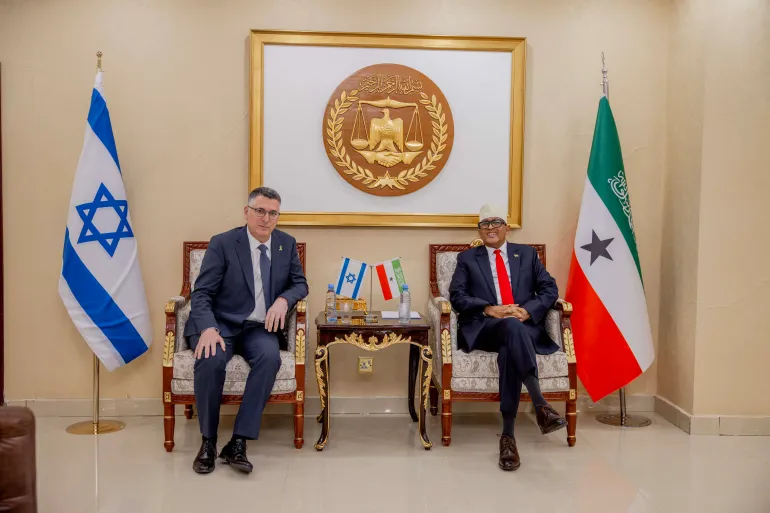
From proximity to Yemen’s Houthis to intersecting interests, recognition of region marks shift towards unconventional alliances.
Israel’s announcement late last year that it would recognise Somaliland as an independent state was followed almost immediately by anger from Somalia and condemnation across Africa and the Middle East. Among criticisms of the move came a warning from Yemen’s Houthis, with the group’s leader, Abdel-Malik al-Houthi, describing it as a “hostile stance” and saying any Israeli presence in Somaliland would be treated as a military target.
Those concerns were reinforced this month when Israel’s foreign minister, Gideon Saar, visited Somaliland and included the strategic port city of Berbera in his itinerary. In a readout after the trip, he said security cooperation was on the agenda. Somaliland officials have since indicated they are open to the possibility of Israeli military presence in the territory – a prospect that would place Israel directly across the Gulf of Aden from the Houthis, thus validating the group’s concerns. This week, al-Houthi said he was “serious” about his earlier threat, adding he would not “hesitate to target any fixed Zionist presence accessible to us”.
Experts say the timing reflects Israel’s growing concern about the threat posed by the Houthis in the southern Red Sea region.
During the genocidal war on Gaza, Israel has traded fire with the Houthis, who have fired missiles and drones from northern Yemen and also targeted Israeli-linked shipping in the Red Sea, in what they said were moves in solidarity with the Palestinians.
“Everyone just looks at the map and understands what Israel is looking for here,” Shiri Fein-Grossman, the CEO of the Israel-Africa Relations Institute and a former member of the Israeli National Security Council, recently told Israeli outlet i24 News.


Related Posts


Stay Informed With the Latest & Most Important News
Previous Post
Next Post


-
 01Trump’s 28-point peace proposal for Ukraine would require land concessions and military reduction
 -
 02‘Not Trump’s dumping ground’: Outrage over arrival of foreign US deportees in tiny African nation
 -
 03Why Thailand and Cambodia are fighting again after Trump ceasefire
 -
 04Pakistan bombs Kabul: Why are Afghanistan and Pakistan fighting?
 -
 05War returns to Iran with Israel, US strikes
 -
 06German arms export licences for Israel surge with focus on sub project
 -
 07Netanyahu’s rejection of Trump’s 15-point Gaza plan unlikely to be final word