

Now Reading: The ‘Fourth Successor’: Iran’s plan for a long war with the US and Israel
-
01
The ‘Fourth Successor’: Iran’s plan for a long war with the US and Israel
The ‘Fourth Successor’: Iran’s plan for a long war with the US and Israel


Tehran built a doctrine to absorb shock, survive decapitation strikes and turn time into a weapon.
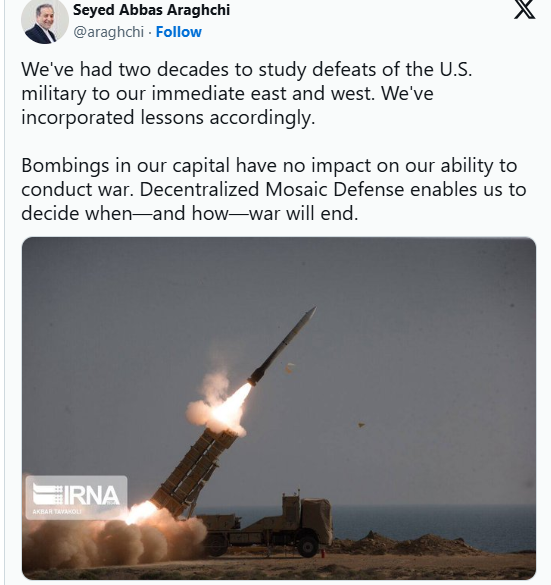
When Iranian Foreign Minister Abbas Araghchi said Tehran had spent two decades studying US wars to build a system that could keep fighting even if the capital was bombed, he was describing more than resilience; he was outlining the logic of Iran’s defence doctrine.
At the centre of that doctrine is what Iranian military thinkers call “decentralised mosaic defence” – a concept built on one core assumption: that in any war with the United States or Israel, Iran may lose senior commanders, key facilities, communications networks and even centralised control, but must still be able to keep fighting.
That means the priority is not simply defending Tehran, or even protecting the supreme leadership itself. It is preserving decision-making, keeping combat units operational and preventing the war from ending with a single devastating strike.
In that sense, Iran’s military was not built for a short war. It was built for a long one.
What is mosaic defence?
“Mosaic defence” is an Iranian military concept most closely associated with the Islamic Revolutionary Guard Corps (IRGC), particularly under former commander Mohammad Ali Jafari, who led the force from 2007 to 2019.
The idea is to organise the state’s defensive structure into multiple regional and semi-independent layers instead of concentrating power in a single command chain that could be paralysed by a decapitation strike.
Under this model, the IRGC, the Basij, regular army units, missile forces, naval assets and local command structures form parts of a distributed system. If one part is hit, others keep functioning. If senior leaders are killed, the chain does not collapse. If communications are severed, local units still retain the authority and capacity to act.
The doctrine has two central aims: to make Iran’s command system difficult to dismantle by force, and to make the battlefield itself harder to resolve quickly by turning Iran into a layered arena of regular defence, irregular warfare, local mobilisation and long-term attrition.
That is why Iranian military thinking does not treat war primarily as a contest of firepower. It treats it as a test of endurance.
Why did Iran adopt this model?
Iran’s shift towards this model was shaped by the regional shocks that followed the US invasion of Afghanistan in 2001 and Iraq in 2003.
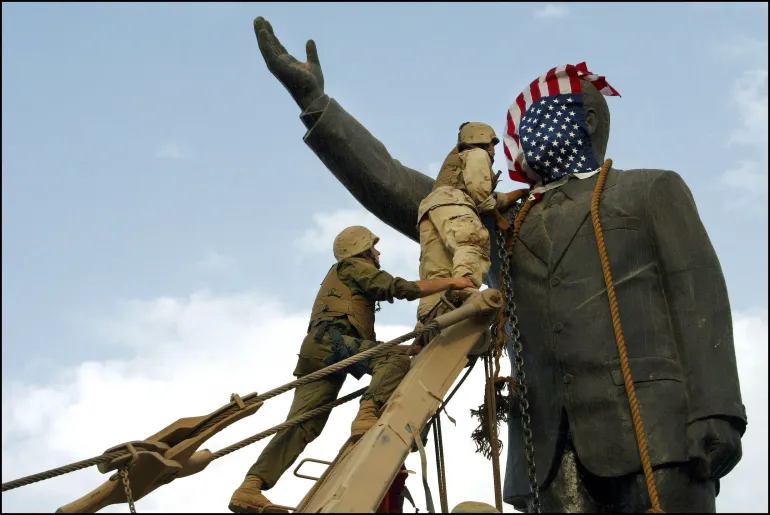
The rapid collapse of Saddam Hussein’s regime appears to have left a deep mark on Iranian strategic thinking. Tehran saw what a highly centralised state looked like when confronted with overwhelming American military power: The command structure was struck, the system fragmented and the regime fell quickly.
Rather than making its military more dependent on central control, it moved towards diffusion. Rather than assuming it could match US or Israeli conventional superiority, it focused on surviving it.
Iran’s doctrine assumes that any invading or attacking force will have far superior conventional technology, air power and intelligence capabilities. The answer, in Iranian thinking, is not symmetrical confrontation. It is to disrupt the enemy’s advantages, prolong the conflict and raise the cost of continuing it.
How would it work in war?
In practice, the doctrine assigns different roles to different institutions.
The regular army, or Artesh, is expected to absorb the first blow. Its armoured, mechanised and infantry formations serve as the initial line of defence, tasked with slowing enemy advances and stabilising the front.
Air defence units, using concealment, deception and dispersal, try to blunt enemy air superiority as much as possible.
The IRGC and the Basij then take on a deeper role in the next stage of conflict. Their task is to turn the war into one of attrition through decentralised operations, ambushes, local resistance, disruption of supply lines and flexible operations across varied terrain, including urban centres, mountains and remote regions.
This is where the Basij becomes especially important. Originally founded by order of Ayatollah Ruhollah Khomeini, the force was later more tightly integrated into the IRGC’s wartime structure. After 2007, its units were folded into a provincial command system spanning Iran’s 31 provinces, giving local commanders wider room to act according to geography and battlefield conditions.


Related Posts
Stay Informed With the Latest & Most Important News
Previous Post
Next Post


-
 01Ayatollah Khamenei’s assassination: A new chapter for Iran, a region at a crossroads
 -
 02PSX opens week in the green, gains more than 7,000 points during intraday trade
 -
 03Rachel Zegler is serenading crowds of people in central London almost every night for free
 -
 04Hopes grow for a breakthrough in US-Iran talks as Pakistan mediates
 -
 05‘No worries’: Trump downplays Chinese military drills around Taiwan
 -
 06Marijuana smells and rowdy fans: Why Arthur Ashe Stadium and the US Open are so unique and sometimes divisive
 -
 07Russia and Ukraine agree prisoner swap, but little other progress in Istanbul talks