




Now Reading: ‘Jaws’ turns 50. It changed pop culture and our perception of sharks
-
01
‘Jaws’ turns 50. It changed pop culture and our perception of sharks
‘Jaws’ turns 50. It changed pop culture and our perception of sharks


‘Jaws’ turns 50. It changed pop culture and our perception of sharks
WNN_
We hardly see the cartilaginous villain of “Jaws” before it tears through a skinny-dipper, a dog, a little boy and an overconfident fisherman. It takes nearly two hours to finally watch the great white shark leap out of the water to swallow the gruff veteran Quint.
Until then, we only really catch its dorsal fin before victims are ripped under the waves as the water around them turns the color of ketchup. “Jaws” is credited with inventing the summer blockbuster. It inspired decades of creature features and suspenseful flicks. It kickstarted a whole subgenre of shark-centric horror (with diminishing returns).
It also inflamed our fear of sharks as man-eating monsters, said Jennifer Martin, an environmental historian who teaches at the University of California, Santa Barbara. “I’m struggling to think of a parallel example of a film that so powerfully shaped our understanding of another creature,” she said. “They were killing machines. They were not really creatures. They weren’t playing an ecological role.
” Fifty years on, “Jaws” preys on our existing fears of the oceanic unknown. The film even briefly influenced the popularity of shark-killing tournaments after its release, Martin said. But it also enticed marine biologists and researchers to better understand the deranged shark at its center.
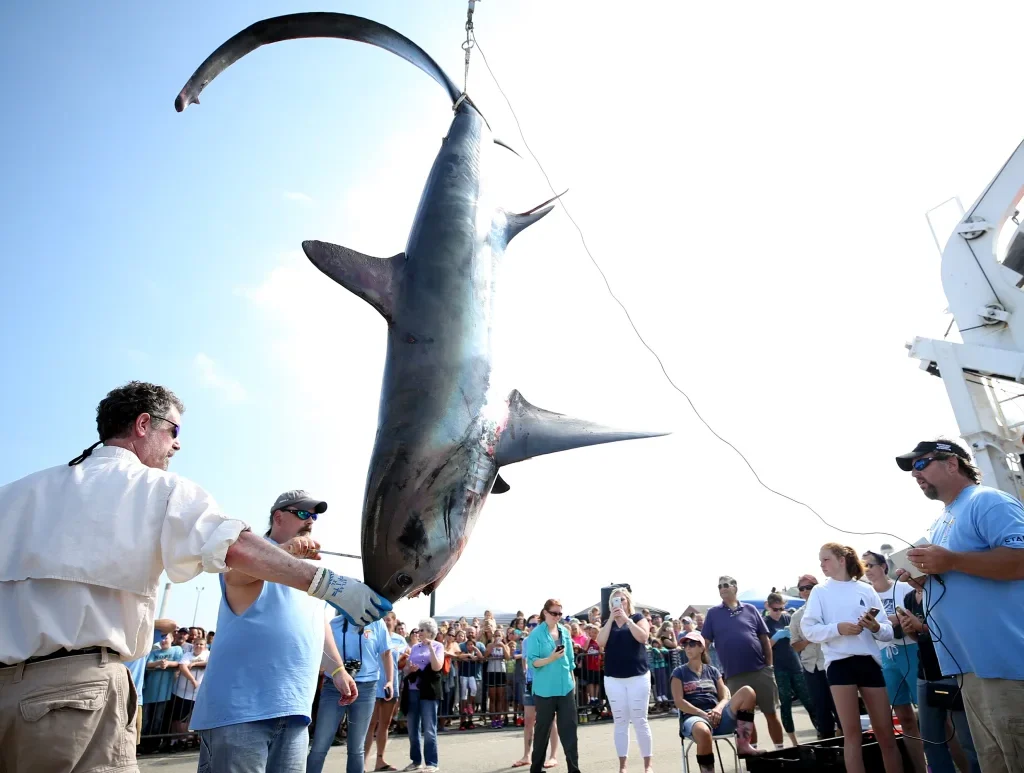
Real white sharks are not as large as the demonic fish in “Jaws,” nor do they hunt humans for bloodsport. But they are certainly intimidating, and they do occasionally bite the odd swimmer, sometimes fatally.
“Being bitten by a wild animal, and in particular one that lives in the ocean, was frightening for us already,” said Gregory Skomal, a marine biologist who has spent decades studying white sharks. “That’s really what I think ‘Jaws’ did — it put the fear in our face.”
Who wants to feel like prey?

How sharks went from ‘garbage eaters’ to ‘man-eaters’
In the decades before “Jaws,” white sharks weren’t considered to be among the ocean’s most fearsome predators.
In the early 20th century, many sharks were thought of as “garbage eaters,” Martin said: Coastal cities dumped their garbage in the ocean, and clever sharks learned to anticipate the barges’ arrival. Sharks, city dwellers thought, were “not very beautiful, not very commercially important,” Martin said. “An animal that’s in an in-between space — sort of a pest, sort of dangerous.”
After some misbegotten attempts to fish sharks commercially, humans started to invade the waters where sharks hung out, and sharks graduated from pest to predator. With the popularization of maritime activities like scuba diving and surfing in the mid-20th century, people were spending more time underwater, which meant they were more likely to bump into a shark, Martin said.


Related Posts



Stay Informed With the Latest & Most Important News
Previous Post
Next Post






-
 01Unusual pushback, ‘dangerous precedent’: What the first meeting of Kennedy’s CDC advisers reveals about the future of vaccines in America
 -
 02Putin and Trump’s envoy set for key Ukraine talks in Moscow
 -
 03PCB slaps hefty fine on Naseem Shah for social media post on Maryam Nawaz
 -
 04The US economy rebounded sharply in the second quarter
 -
 05What will happen now that Trump has turned on Putin?
 -
 06Photos: Thousands march in Turkiye in support of Gaza on New Year’s Day
 -
 07FOM condemns Indian minister’s remarks on Kashmir issue, warns against underestimating resolve to thwart ‘any adventurism’