




Now Reading: Inside Trump’s last 24 hours as he willed his agenda bill over the finish line
-
01
Inside Trump’s last 24 hours as he willed his agenda bill over the finish line
Inside Trump’s last 24 hours as he willed his agenda bill over the finish line


WNN —
After nearly 20 hours straight of working the phones – using both threats and assurances to cajole Republicans into supporting his sweeping domestic agenda bill – President Donald Trump seemed to grow exasperated while watching coverage of the plodding floor process on television.
“What are the Republicans waiting for??? What are you trying to prove??? MAGA IS NOT HAPPY, AND IT’S COSTING YOU VOTES!!!” Trump posted on social media at midnight, as the vote seemed stalled.
Fourteen hours later, the bill had passed, with only two Republican defections.
Trump is expected to sign it in a major ceremony on Friday afternoon at the White House – punctuated by a fly-over of the B-2 bombers who dropped bunker-buster bombs on Iranian nuclear facilities last month, according to a White House official.
The spectacle will only underscore what a consequential stretch of days it has been for the president, who now appears at the height of his political power roughly six months into his second term.
Last week’s Supreme Court decision paved the way for even more expansive use of executive authority. His strikes on Iran’s nuclear sites appear to have created new momentum toward a ceasefire deal in Gaza. A NATO summit last week, tailored to his preferences, resulted in new defense spending commitments after years of pressure from Trump.
At home, Trump is presiding over an economy that continues to create jobs, despite continued unease over the threat of tariffs. His hardline immigration enforcement tactics, decried by opponents as inhumane or illegal, have reportedly brought down unlawful crossings at the US southern border to historic lows.
“I think I have more power now, I do,” Trump said outside Air Force One Thursday, hours after his agenda bill passed the House.
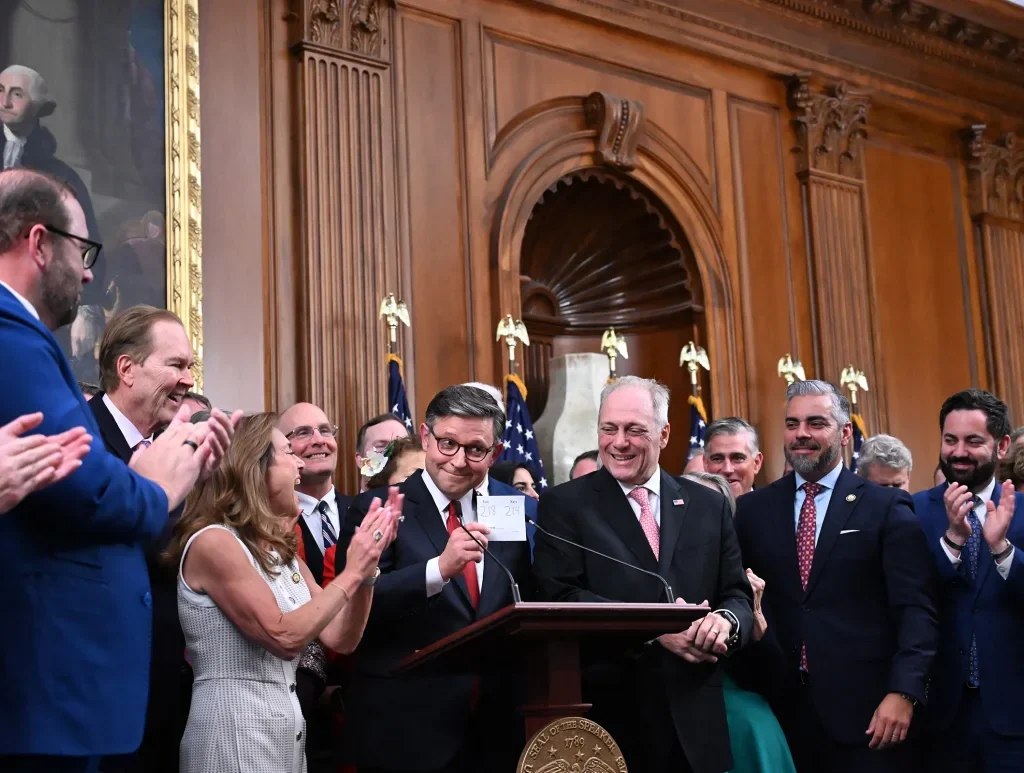
House Speaker Mike Johnson, center, alongside Republican lawmakers, shows the final tally of the vote on US President Donald Trump’s sweeping domestic policy bill during a press conference at the US Capitol in Washington, DC, on July 3.
“Dinner after dinner, engagement after engagement at Mar-a-Lago — you know, those relationships, and the president’s focus on relationships, carried us through in kind of a cascade here,” the official said, adding they had lost count of the number of meetings Trump held on the bill.
Democrats have already begun formulating plans to tether Trump and Republicans to the new law’s changes to Medicaid, singling out individual cases of Americans’ deprived of care. Their argument was encapsulated by House Minority Leader Hakeem Jeffries’ marathon speech on the House Floor on Thursday.
“Leadership requires courage, conviction, compassion — and yet what we have seen from this administration and co-conspirators on the Republican side of the aisle is cruelty, chaos and corruption,” Jeffries said in his address, which broke a record for the longest floor speech in modern history.
Polling shows Americans are broadly skeptical of the bill, creating a task for Trump in the months ahead to change perceptions of the bill he worked assiduously to get passed.
He could be aided by the bill’s strategic sequencing, which enacts the tax cuts in the near-term but pushes off major changes to Medicaid and food assistance programs until after next year’s midterm elections.
Yet recent history is littered with presidents who, after using congressional majorities to push through major legislation meant to burnish their legacy, later lamented not doing enough to sell the bill to the American public – after their party members paid the price at the ballot box.
In meetings in the Cabinet Room and Oval Office, a magnanimous Trump signed place cards, took photos and paid his visitors compliments on their television appearances, according to people familiar with the sessions. He handed out mementos and showed guests around the constantly redecorated Oval Office.
But he was also firm that after weeks of back-and-forth between the two chambers of Congress, there would be no more changes to the bill.
“He wanted to get this done, and that was clear,” one lawmaker who met with Trump said.
“The message he sent to all of them was very clear, that this bill has been negotiated a lot, but there’s not going to be any more changes to it,” Rep. Steve Scalise, the House Majority Leader, said Thursday on Capitol Hill. “The time for that is over, and I think it took them still a few hours after to realize he was serious.”
When discussing the bill, the president urged the lawmakers to maintain GOP unity and avoid giving Democrats a victory by denying him his signature legislation, one person familiar with the meetings said.
Outside Air Force One on Thursday evening, Trump said he offered “no deals – what I did is we talked about how good the bill is.”
And while Trump’s threat of backing primary challenges to opponents of his bill remained ever-present in many Republicans’ minds, the president opted to leave the warning mostly unsaid as he cajoled members in the West Wing on Wednesday.
“The president was wonderful, as always,” Tennessee Rep. Tim Burchett said in a video posted after the two-hour meeting. “Informative, funny, he told me he likes seeing me on TV, which was kind of cool.”
However, as the night went on and lawmakers argued at the Capitol, one source briefed on the conversations with conservative members said it was conveyed that if members held up this bill, they would be primaried – a message that moved some members towards a vote.
“He is in the strongest position of anybody in generations – probably ever – in terms of impacting primaries for Congress,” the source said. “So anybody coming from a hard-right district, which is most of the conference, will have to deal with that. And he’s just not going to tolerate anyone going against his agenda.”
A White House official pushed back on the notion that there were any direct primary threats but acknowledged that the prospect always loomed over conversations.
What Trump promised hardliners
One person familiar with the meetings with House lawmakers said Trump spoke about the importance of the bill to Republicans’ agenda and argued that economic growth would eclipse any concerns about expanding the deficit — arguments he and his team have been making publicly.
He also promised hardline fiscal hawks he would use his executive authorities to vigorously enforce certain phaseout provisions for green energy tax credits to convince them to vote yes.


Related Posts



Stay Informed With the Latest & Most Important News
Previous Post
Next Post








-
 01Indian woman arrested after suicide of man she accused of sexual misconduct
 -
 02Trump in China for talks with Xi Jinping
 -
 03Ukraine says ‘understanding’ reached on US peace plan, as Trump envoy to meet Putin
 -
 04At least 19 dead in Nepal after Gen Z protests at corruption and social media ban
 -
 05Trump now says 10 aircraft shot down during Pak-India conflict
 -
 06Trump’s 50% tariff on India kicks in as Modi urges self-reliance
 -
 07War returns to Iran with Israel, US strikes