




Now Reading: At 90, the Dalai Lama braces for final showdown with Beijing: his reincarnation
-
01
At 90, the Dalai Lama braces for final showdown with Beijing: his reincarnation
At 90, the Dalai Lama braces for final showdown with Beijing: his reincarnation


Hong KongWNN —For much of the past century, the Dalai Lama has been the living embodiment of Tibet’s struggle for greater freedoms under Chinese Communist Party rule, sustaining the cause from exile even as an increasingly powerful Beijing has become ever more assertive in suppressing it.
As his 90th birthday approaches this Sunday, the spiritual leader for millions of followers of Tibetan Buddhism worldwide is bracing for a final showdown with Beijing: the battle over who will control his reincarnation.
On Wednesday, the Dalai Lama announced that he will have a successor after his death, and that his office will have the sole authority to identify his reincarnation.
“I am affirming that the institution of the Dalai Lama will continue,” the Nobel Peace laureate said in a video message to religious elders gathering in Dharamshala, India, where he has found refuge since Chinese communist troops put down an armed uprising in his mountainous homeland in 1959.
The cycle of rebirth lies at the core of Tibetan Buddhist belief. Unlike ordinary beings who are reborn involuntarily under the influence of karma, a revered spiritual master like the Dalai Lama is believed to choose the place and time of his rebirth – guided by compassion and prayer – for the benefit of all sentient beings.
But the reincarnation of the current Dalai Lama is not only pivotal to Tibetan Buddhism. It has become a historic battleground for the future of Tibet, with potentially far-reaching geopolitical implications for the broader Himalayan region.
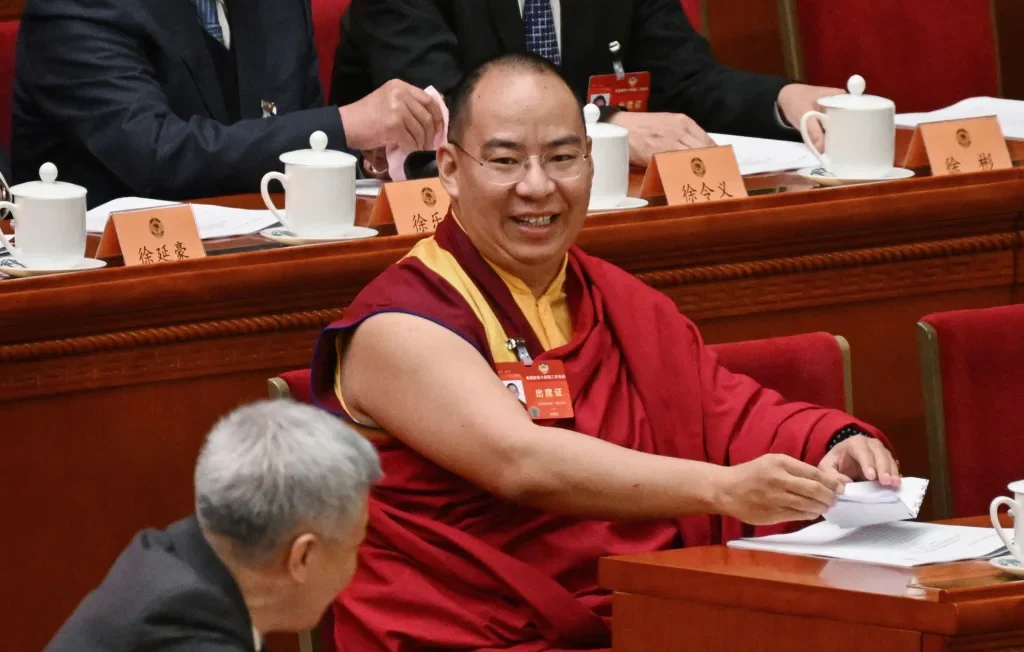
The Chinese government-selected 11th Panchen Lama Gyaincain Norbu at the Great Hall of the People in Beijing on March 4, 2024.
Historically, dalai lamas and panchen lamas have acted as mentors to each other and played a part in identifying or endorsing each other’s reincarnations – a close relationship likened by Tibetans to the sun and the moon. But in 1995, years after the death of the 10th Panchen Lama, Beijing upended tradition by installing its own Panchen Lama in defiance of the Dalai Lama, whose pick for the role – a six-year-old boy – has since vanished from public view. Beijing’s Panchen Lama is seen as an imposter by many Tibetans at home and in exile. He is often shown in China’s state-run media toeing the Communist Party line and praising its policies in Tibet. Last month, in a rare meeting with Chinese leader Xi Jinping, the Tibetan monk reaffirmed his allegiance to the rule of the Communist Party and pledged to make his religion more Chinese – a tenet of Xi’s policy on religion. Experts and Tibetan exiles believe Beijing will seek to interfere in the Dalai Lama’s eventual succession using a similar playbook – appointing and grooming a candidate loyal to its rule, with the backing of the state-appointed Panchen Lama and other senior lamas cultivated by the government. That could lead to the emergence of two rival dalai lamas: one chosen by his predecessor, the other by the Communist Party. Jinpa, the Dalai Lama’s translator, is unfazed by that prospect. “Personally, I don’t worry about that, because it’s kind of a joke. It’s not funny because the stakes are so high, but it’s tragic,” he said, referring to Beijing’s likely attempt to appoint its own dalai lama. “I just feel sorry for the family whose child is going to be seized and told that this is the dalai lama. I’m already feeling sad for whoever’s going to suffer that tragedy.”

The search for a dalai lama
Tibetan Buddhism reveres its spiritual leader as the human manifestation of the Bodhisattva of Compassion – an enlightened being who, rather than entering nirvana, chooses to be reborn to help humanity. The current Dalai Lama is the latest in a long lineage of reincarnations that have spanned six centuries.
The search for a dalai lama’s rebirth is an elaborate and sacred process. Important clues are the instructions or indications left by a predecessor (it could be as subtle as the direction in which the deceased dalai lama’s head was turned). Additional methods include asking reliable spiritual masters for their divination, consulting oracles, and interpreting visions received by senior lamas during meditation at sacred lakes.
Following these clues, search parties are dispatched to look for young children born after the dalai lama’s death. Candidates are subject to a series of tests, including identifying objects that belonged to the previous incarnation.
But the dalai lama’s reincarnation hasn’t always been found in Tibet. The fourth dalai lama was identified in the late 16th century in Mongolia, while the sixth was discovered about a century later in what is currently Arunachal Pradesh, India.

The Potala Palace in Lhasa, seen here in 2020, was the winter home of the Dalai Lama until he went into exile in 1959.
In 2011, the Dalai Lama devolved his political power to the democratically elected head of the Tibetan government-in-exile, retaining only his role as the spiritual head of the Tibetan people.
Sangay, who took up the baton as the political leader of the exiled government, said that by making the transition to democracy the Dalai Lama wanted to ensure Tibetans can run the movement and the government on their own, even after he is gone.
“He has specifically said: ‘You cannot just rely on me as an individual… I’m mortal. The time will come when I won’t be there. So it is for the Tibetan people, while I’m here, to transition to full-fledged democracy – with all its ups and downs – and to learn from it and grow, mature and be stronger, moving forward,’” he said.
That goal has taken on added urgency as the Tibetan movement for safeguarding their culture, identity and genuine autonomy increasingly finds itself in a precarious moment.


Related Posts

Stay Informed With the Latest & Most Important News
Previous Post
Next Post







-
 01Spectacular Photos of Nature from the World’s Most Scenic Spots
 -
 02Who was Haytham Ali Tabatabai, Hezbollah official killed by Israel?
 -
 03Bondi Beach shooting: How tough are Australia’s gun laws?
 -
 04Libya’s army chief killed in air crash in Turkey
 -
 05‘Trump Gold Card’ launches, offering expedited immigration pathway with a $1 million fee
 -
 06‘A gasp of wonderment escaped our lips’: The dazzling discovery of Tutankhamun’s tomb
 -
 07No survivors after plane carrying 48 people goes down in Russian far east