


Now Reading: China spectacle shows dangers of Trump’s high-risk trade policy
-
01
China spectacle shows dangers of Trump’s high-risk trade policy


The military might of the People’s Republic of China was on full display in a parade marking the 80th anniversary of the end of World War Two on Wednesday.
Thousands of miles away, at the White House in Washington DC, Donald Trump was paying attention.
“They were hoping I was watching, and I was watching,” he said.
The American president didn’t detail his thoughts about the massive celebration sprawled across Tiananmen Square, except that it was “very, very impressive”. The message from China – to Trump and to the world – however, seems fairly clear.
There is a new and growing centre of power in the world and a new alternative to the American-backed order of the past century.
Trump’s remarks during a meeting in the Oval Office with Polish President Karol Nawrocki, also on Wednesday, shed little light on the matter.
They were the culmination of a typically circuitous series of reflections by the American president on the happenings in China over the past several days. It was a mix of ambivalence, grievance and concern.
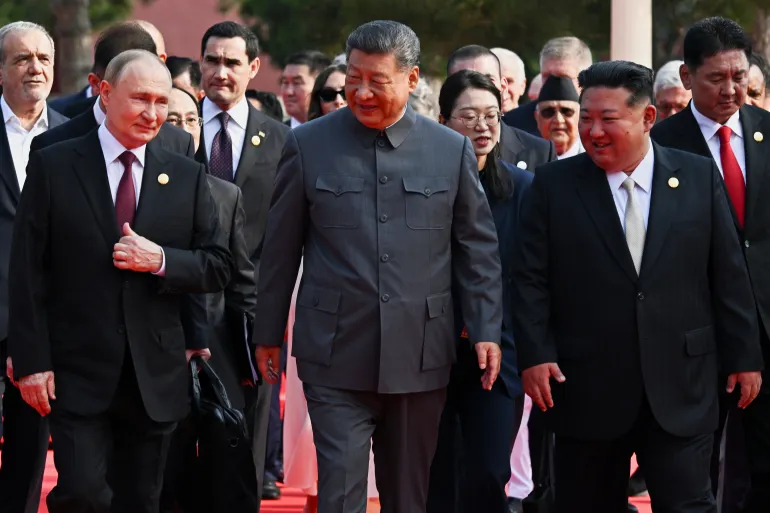
During a Tuesday podcast interview, Trump was nonchalant about the parade, saying he was “not concerned” about the Chinese show of force in front of Putin, North Korean leader Kim Jong Un and more than two dozen other heads of state.
By Tuesday night, however, he was grousing on his Truth Social website that China wasn’t giving credit to the US for its support in World War Two.
“Please give my warmest regards to Vladimir Putin and Kim Jong Un, as you conspire against the United States of America,” he wrote.
Of course, China’s parade – while dripping with futuristic weaponry – offered some historical narrative, as well – an attempt by the communist government to lay claim to a larger role in defeating fascism and imperialism in World War Two. If that conflict launched the so-called “American century”, Beijing may be hoping a newfound respect for its role could smooth the transition to a Chinese-crafted future.
“It’s the first step in a concerted effort to rewrite the rules of the road,” said Richard Wilkie, secretary of veteran’s affairs during Trump’s first presidential term. “And you do that first by rewriting history.”
He added that Chinese nationalists and US forces had much more to do with Japan’s Asian defeat than the communist army.
The parade wasn’t the only image coming out of China this week that American policymakers intent on maintaining a US-led international order might find concerning, however.
Trump also has been ambivalent about conflicts and concerns far from US soil, instead focusing on a “sphere of influence” that includes a keen interest in America’s immediate geographic neighbourhood – Greenland, Panama and Canada, among them.
The danger for Trump, however, is that his sweeping trade actions may end up being all risk and no reward. There are growing indications that the newly constructed America-centric trade regime could be dismantled in the days ahead by the US judiciary.


Related Posts


Stay Informed With the Latest & Most Important News
Previous Post
Next Post



-
 01Four years on, Russia’s war in Ukraine has transformed conflict and shattered global security
 -
 02The highs and lows of ‘And Just Like That’ – including that finale
 -
 03AI investments and Syria’s development – this week’s business headlines from the Middle East
 -
 04Asia Cup: Pakistan beat UAE to enter Super Fours; face India on Sunday
 -
 05Microsoft pledges $50 billion to tackle growing AI inequality
 -
 06PM Shehbaz says water ‘lifeblood’ of region, must never be weaponised
 -
 07Earthquake rescue teams battling to reach survivors in Afghanistan