




Now Reading: ZIONISM’S ENDURING SETTLER-COLONIALISM
-
01
ZIONISM’S ENDURING SETTLER-COLONIALISM

“They came to a land that had a people and they made it a land without a people, so they could become a people without a land. But the land remained, and the people remained, and the memory remained.” — Mahmoud Darwish, Farasat al-Ghazal
“They did not expel us from our homes because they hated us. They expelled us because they wanted our homes.” — Ghassan Kanafani, Returning from Haifa
“…this new type of criminal, who is in actual fact hostis generis humani, commits his crimes under circumstances that make it well-nigh impossible for him to know or to feel that he is doing wrong.” — Hannah Arendt, Eichmann in Jerusalem: A Report on the Banality of Evil
THE HOOK
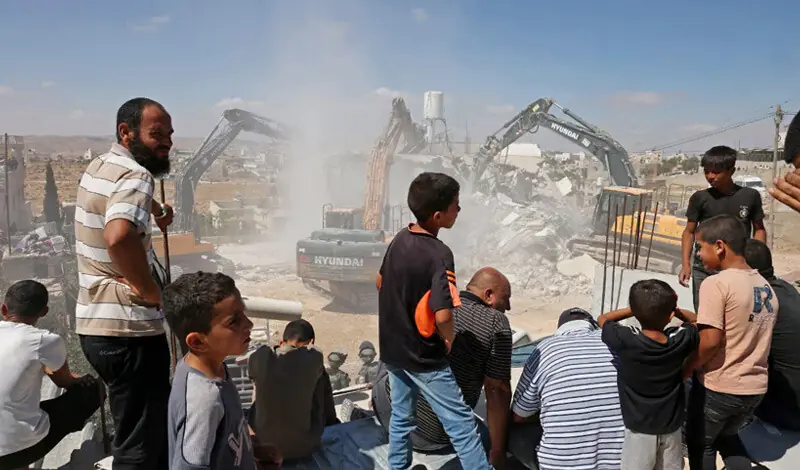
The mid-August 2026 siege of Qusra, a Palestinian town southeast of Nablus, by violent Zionist settlers is a metaphor for the structured violence that has come to define the occupied West Bank. Over nearly two weeks, Zionist settlers encircled residential homes on the village outskirts, cut off water and electricity and established outposts directly in the front yards of Palestinian homes.
Rather than coming to the aid of the besieged Palestinians, Zionist soldiers were documented praying alongside the blockading settlers. Targeted Palestinian homes, including the property of a Palestinian-American family on the Ras al-Ain hilltop, have since been declared a “closed military zone” and their properties repurposed into military barracks. The families are homeless now.
Qusra is not an isolated act of lawlessness, nor is the violence sporadic — it is evidence of how the Zionist state and the settler movement function as an integrated, singular apparatus. It shouldn’t surprise anyone because it illustrates the foundational — I choose the word carefully — Zionist premise of territorial acquisition through native erasure. The employment of localised terror effectively serves today as the vanguard for state-sanctioned annexation, as it did when the Zionists began settling in Palestine a century ago.
Qusra is also not the first or only target. Within just the Nablus Governorate, settlers have targeted Qaryut, Tell, Jalud, Burin, Osarin. The story is generally the same: intimidation, attacks, arson, looting, killing, sparing not even the domesticated animals. The Jordan Valley, Central West Bank, Southern West Bank, villages in the Hebron Hills, settler terror is everywhere.
While the world has understandably focused on the genocide and destruction in Gaza, Zionist settler violence has deepened across the Occupied West Bank. At the same time, the global diplomatic ritual of calling for a two-state solution in Palestine increasingly bears little resemblance to the reality on the ground. In fact, it may be a smoke-screen that facilitates a continuing land-grab. The current settler activity is not an aberration, argues Ejaz Haider, but a logical outcome of the colonial-settler project of Zionism itself…
These are not hidden atrocities committed in the shadows of an unmonitored frontier. By forcing the international community to witness state-backed displacement occurring with absolute impunity, Qusra and other unfortunate Palestinian towns not only shatter the narrative of the ‘rogue settler’, they depict what lies at the dark heart of Zionism: structural violence inherent in Zionism.
The strategy of colonisation has been playing out in Palestine since Britain and France (the United States was not in play at the time) decided to find the ‘solution’ to Europe’s Jewish problem in Palestine, their terra nullius. The evil is marauding the land now.
I intend here to make four points: one, settler violence in the Occupied West Bank, long a part of the Zionist entity’s grey zone operations, is now centre stage. Zionism’s ‘little green men’ are now unmasked.
Two, this strategy of violence is not a recent phenomenon. Its ideological architecture was built on the foundations of what the father of Zionism Theodore Herzl called Der Judenstaat [The Jewish State] and Revisionist Zionism’s founder Ze’ev Jabotinsky The Iron Wall. The monster was born much before the crossing into the West Bank of ultranationalist Rabbi Zvi Yehuda Kook and his disciples after the 1967 War. Today’s settlers are not just a synecdoche of Zionism, they are Zionism.
Three, a pile of evidence about the malevolence that makes up Zionism should disabuse anyone of the idea of a two-state solution. I have written about it previously but it bears repeating, because that red-herring informs much of the pro forma international diplomacy seeking to find a solution. The Zionist entity has absolutely no intention of letting a Palestinian state come into existence.
Four, flowing from the points above, for the Middle East to achieve peace, the world must clearly and without equivocation call for an end to Zionism, uproot it branch and tree, to be replaced by a Palestinian state where all denominations can live in amity.
EARLY SETTLERS AND THEIR MOTIVES (1882-1948)
The ideological and economic foundations of the Zionist state were laid during the first (1882–1903) and second (1904–1914) aliyahs [waves of immigration].
Zionist-American sociologist Gershon Shafir’s work demonstrates that early European Jewish settlers quickly realised that their survival depended on how they managed land and labour. While the First Aliyah relied briefly on a ‘planter model’, employing local Palestinian agricultural workers, the influx of highly ideologised, socialist immigrants during the Second Aliyah fundamentally altered this trajectory.
To build an independent national economy, these settlers instituted the policy of Kibush Ha’avoda [The Conquest of Labour]. This doctrine mandated that Jewish enterprises hire exclusively Jewish workers. The policy systematically shut local Palestinians out of the emerging economy. Shafir notes that these exclusive labour practices, along with the collective agricultural models of the kibbutz and moshav, were explicitly designed to build an isolated, self-sufficient economic infrastructure that marginalised the indigenous population.
Shafir is a good example of a liberal Zionist. While his academic work is intensely critical of the Zionist state’s policies and foundational historical narratives, he nonetheless operates within a framework that seeks a two-state chimeric solution rather than accepting the ugliness situated at the core of the Zionist ideology, and refuses to overturn the original sin or accept that no such solution is possible.
In his influential 1923 essay The Iron Wall, Jabotinsky rejected the notion that the indigenous Arab population would ever voluntarily accept their own displacement: “Every indigenous people will resist alien settlers… Zionist colonisation, even the most restricted, must either be terminated or carried out in defiance of the will of the native population.” He concluded that the Zionist project could only succeed under the protection of an unyielding “iron wall” of military supremacy.
Compare this with what Zionist historian Benny Morris wrote in his book 1948: A History of the First Arab-Israeli War: “Years later, after the establishment of Israel, [its first prime minister David] Ben-Gurion expatiated on the Arab perspective in a conversation with the Zionist leader Nahum Goldmann, founder of the Jewish World Congress: ‘I don’t understand your [Goldmann’s] optimism… Why should the Arabs make peace? If I [were] an Arab leader I would never make terms with Israel. That is natural… We come from Israel, it’s true, but two thousand years ago, and what is that to them? There has been anti-Semitism, the Nazis, Hitler, Auschwitz, but was that their fault?’”
This early rhetoric proves that the movement’s pioneers understood settlement not as a peaceful return to an empty land, but as an aggressive colonial campaign requiring absolute physical domination. This is why Ben-Gurion saw the Partition plan as a stepping stone to Palestinian expulsion: “With compulsory transfer, we [would] have a vast area [for settlement]. I support compulsory transfer. I don’t see anything immoral in it.”
PARAMILITARY POLICIES, PLAN DALET AND NAKBA (1939-48)
As the British Mandate drew to a close following World War II, the structural imperative for territorial control for the Zionists shifted from economic exclusion to direct military action.
During the 1940s, Zionist underground paramilitary organisations, primarily the Irgun and the Lehi, conducted asymmetric urban warfare campaigns. These operations targeted both British administrators — the 1946 bombing of the King David Hotel is a case in point — and Palestinian civilians, and culminated in events like the Deir Yassin massacre in April 1948, ahead of the war in May.
While mainstream Zionist leaders initially distanced themselves from these splinter factions, these groups were quickly absorbed into the central military command of the Zionist paramilitary organisation the Haganah under Ben-Gurion. The Haganah would later form the core of the Zionist entity’s military.
The merger of these early paramilitary groups integrated radical tactics into formal state doctrine. The operational climax of this strategy was Plan Dalet (Plan D), launched by the Haganah high command in April 1948. Historian Ilan Pappé, Israeli but anti-Zionist, characterises Plan D as a deliberate blueprint for ethnic cleansing. The plan provided a systematic military methodology for entering Arab towns, expelling residents across international borders and destroying villages, to prevent any future return.
In contrast, Morris argues that the flight of the Palestinians was a chaotic byproduct of war rather than a pre-designed master plan. The irony is that Morris’ own extensive empirical documentation of Plan D reveals specific, brutal operational mechanisms that triggered mass displacement.
Ben-Gurion had entrusted Chief of Operations Yigael Yadin with drafting Plan D. While Yadin authored the strategic plan, a young Yitzhak Rabin served as a field commander responsible for executing its tactical dimensions on the ground, most notably during Op Dani in July 1948.
During this campaign, Zionist forces captured the strategic twin cities of Lydda and Ramle. Following an outbreak of local resistance, Ben-Gurion ordered the removal of the population. Rabin formally signed and issued the operational directive, which explicitly stated: “The inhabitants of Lydda must be expelled quickly, without regard to age.”
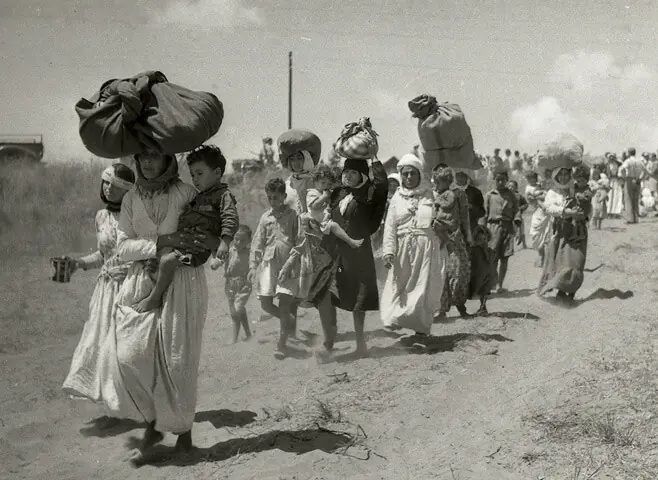
Consequently, between 50,000 and 70,000 Palestinian civilians were driven from their homes. They were forced to march eastwards towards Arab Legion lines in intense summer heat, leading to hundreds of deaths from dehydration and exhaustion. Significant civilian casualties also occurred when Zionist forces fired into a local mosque to suppress resistance. In 1979, a Zionist government censorship board banned Rabin from including a first-person account of the expulsions in his memoirs.
According to Morris’ research, the execution of Plan D, diabolically simple, relied on four primary tactics: armed intimidation (surrounding Arab villages and issuing ultimatums to local leadership, demanding immediate surrender and the handover of all weapons); psychological warfare (broadcasting warnings via loudspeakers and radio to induce panic, often weaponising reports of nearby massacres to accelerate flight); sustained mortar shelling (bombarding civilian population centres to break local resistance before the Zionist ground troops entered the villages and towns); and systematic demolitions (dynamiting houses, burning crops and planting mines in the ruins of depopulated villages to ensure that the physical infrastructure of Palestinian life was completely erased, rendering return impossible).
The resulting Nakba [catastrophe] displaced over 700,000 Palestinians and depopulated more than 400 villages, transforming the land to secure a demographically homogeneous Zionist state.


Related Posts

Stay Informed With the Latest & Most Important News
Previous Post
Next Post




-
 01AI data centers have become sitting ducks in the Iran war
 -
 02How the Iran war is rewriting the economics of power … and why Pakistan must read the signals first
 -
 03Israel to reopen Gaza crossing after search for last dead hostage’s body ends
 -
 04Why India’s RSS is lobbying the West amid attacks on minorities at home
 -
 05What does Israel want in Somaliland?
 -
 06Floating doves to sunken ships: 18 of the most striking images of 2025
 -
 07Zelensky says allies asked him to scale back attacks on Russian energy