



Now Reading: What is the Power of Siberia 2 pipeline that Russia, China are planning?
-
01
What is the Power of Siberia 2 pipeline that Russia, China are planning?
What is the Power of Siberia 2 pipeline that Russia, China are planning?

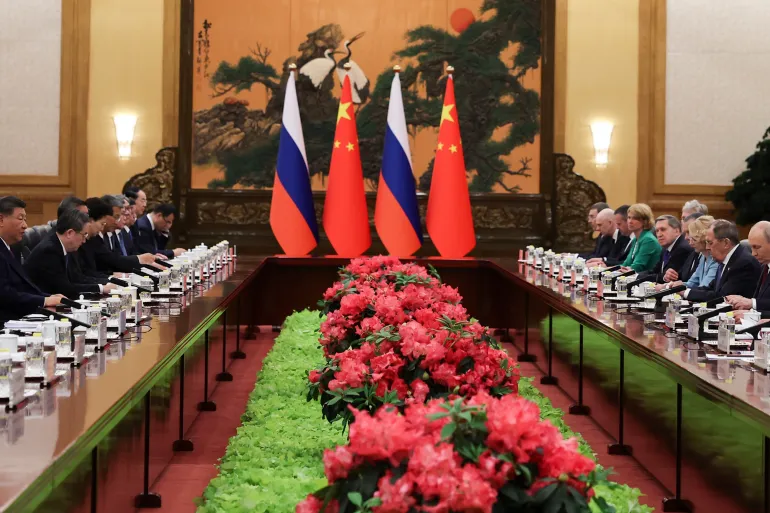
Analysts say Russia wants to replace lost gas revenue while China seeks to diversify and secure its energy supplies.
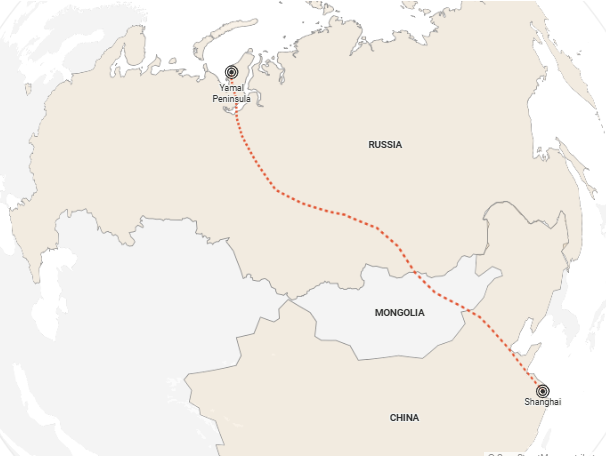
On the agenda at this week’s Russia-China summit between Presidents Vladimir Putin and Xi Jinping is the long-delayed Power of Siberia 2 (POS-2) project, a proposed 2,600km (1,616-mile) natural gas pipeline that would carry Russian gas from western Siberia through Mongolia to China. On Wednesday, the two countries said they had reached an understanding about the route and construction of the pipeline, but other details have yet to be negotiated.
Once built, the pipeline is expected to have a capacity of 50 billion cubic metres (1.77 trillion cubic feet) per year, equivalent to about 525 terawatt-hours of energy – nearly twice the United Kingdom’s annual electricity consumption.
The pipeline would be nearly as large as Nord Stream 1, one of Russia’s most important former gas export routes to Europe, which had a design capacity of 55 billion cubic metres (1.94 trillion cubic feet) per year.
Analysts said Russia wants to build the pipeline to replace revenue lost since European countries slashed their gas imports from Russia after Moscow’s full-scale invasion of Ukraine in February 2022.
For China, pipeline gas from Russia could offer a more secure alternative to imported liquefied natural gas (LNG), which is cooled into liquid form and transported by ship.
The new pipeline may sound like a win-win, but analysts said significant hurdles remain before the project can become a reality.
Is the POS-2 pipeline feasible?
The pipeline is logistically feasible as Russia’s state-owned Gazprom, the world’s largest producer of natural gas by reserves, has ample experience of building large-capacity, long-distance pipelines through challenging terrain, Jack Sharples, senior research fellow at the Oxford Institute for Energy Studies,
Is the deal done? Not yet. After Putin met with Xi on Wednesday, Kremlin spokesman Dmitry Peskov told Russian media: “The president said during the talks that, overall, there is already a shared understanding of the main parameters for Power of Siberia 2.”
“There is agreement on the route and on how the project will be built. Some details still need to be finalised, but in general, such an understanding is already in place,” he said.
Peskov conceded there was no timetable for carrying out the project.
POS-2 is “technically challenging” but the hold-up has “always been commercial terms”, Seb Kennedy, CEO and founder of the independent energy market analysis publication Energy Flux,
What’s in it for Russia? For Russia, POS-2 would provide a major new market for gas that was originally intended for Europe, helping state-controlled energy giant Gazprom recover part of the revenue it has lost since Moscow invaded Ukraine. Before the war, “Putin was very much turned towards Europe in terms of economic development,” said Remi Bourgeot, economist at the French Institute for International and Strategic Affairs in Paris and author of the analysis platform epistelem.org.
What are the risks?
Analysts said the pipeline is about more than energy.
It also reflects a broader effort by Russia and China to build closer economic ties and reduce their dependence on a Western-led international order that both countries increasingly view as fractured and unreliable.
During Wednesday’s summit, the leaders echoed this sentiment.
“Even against the backdrop of unfavourable external factors, our interaction and economic cooperation demonstrate strong momentum,” Russian media reported Putin as telling Xi.


Related Posts
Stay Informed With the Latest & Most Important News
Previous Post
Next Post



-
 01Dozens feared dead in air strike on village in northeastern Nigeria
 -
 02Read the 14-point draft agreement between the US and Iran
 -
 03Israel kills more starving Palestinians as US envoy heads to Gaza
 -
 04How Trump’s ‘big, beautiful bill’ frames the defining debate for 2026
 -
 05Russia targets UK military satellites on weekly basis
 -
 06Hunkered at Mar-a-Lago, Trump makes his club a makeshift Situation Room
 -
 07European leaders want to avoid a repeat of previous Trump-Zelensky meeting