
Now Reading: Trump ‘pretty sure’ of Iran deal, but can Pakistan-led efforts end the war?
-
01
Trump ‘pretty sure’ of Iran deal, but can Pakistan-led efforts end the war?
Trump ‘pretty sure’ of Iran deal, but can Pakistan-led efforts end the war?

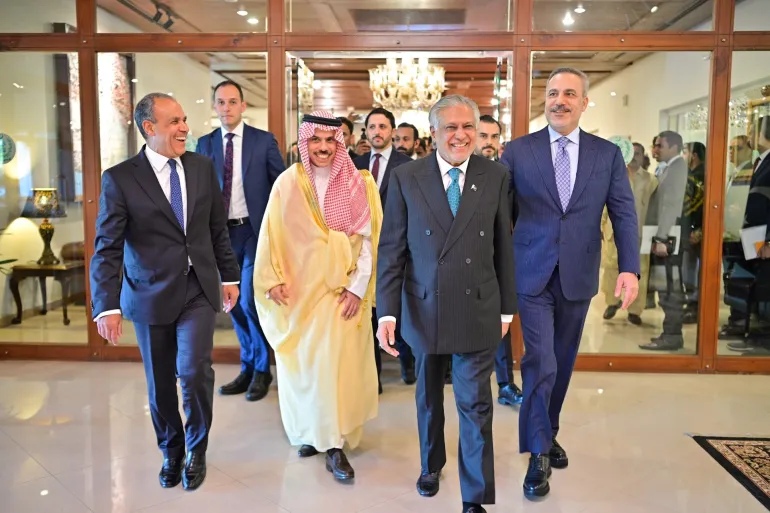
Pakistan, Saudi Arabia, Turkiye and Egypt set up a team for backchannel talks with the US and Iran. But the gulf between US and Iranian positions, a military buildup in the Gulf, and Israel’s spoiler efforts threaten diplomacy.
When the foreign ministers of Saudi Arabia, Turkiye and Egypt landed in Islamabad over the weekend, it marked the second meeting in less than two weeks of a diplomatic track working to contain the fallout of the US-Israel war on Iran and Tehran’s retaliatory strikes across the region.
Pakistan’s Deputy Prime Minister and Foreign Minister Ishaq Dar confirmed at the conclusion of Sunday’s consultations that the US and Iran had expressed confidence in Pakistan to facilitate direct talks. Islamabad, he said, was “honoured” to host them “in the coming days, for a comprehensive and lasting settlement of the ongoing conflict”.
The four ministers, he added, held “a very detailed and in-depth discussion” on the war, reaffirmed “unity to contain the situation, reduce the risk of military escalations and create conditions for structured negotiations”, and agreed to constitute a Committee of Four senior officials, one from each foreign ministry, to work out the modalities of the process.
Besides Dar, the meeting was attended by foreign ministers Hakan Fidan of Turkiye, Badr Abdelatty of Egypt and Prince Faisal bin Farhan Al Saud of Saudi Arabia.
The quadrilateral format first came together on the sidelines of the broader Arab and Islamic consultative meeting in Riyadh, Saudi Arabia, on March 19. What began as a wider gathering has hardened into a focused four-country peace push, with Pakistan acting as the primary channel between Washington and Tehran.

Positions remain far apart
The positions formally put forward by both sides remain structurally incompatible, say analysts.
Washington’s 15-point plan, transmitted to Tehran via Pakistan, includes a one-month ceasefire, a handover by Iran of its highly enriched uranium stockpiles, a halt to further enrichment, curbs on Tehran’s ballistic missile programme and an end to support for regional proxies.
Iran’s counterproposal, outlined by state-funded broadcaster Press TV, citing a senior political security official, calls for a halt to aggression and killings, concrete guarantees against recurrence, reparations, an end to hostilities against Iran’s allies and formal recognition of Iranian sovereignty over the Strait of Hormuz.
Trump told reporters on board Air Force One on Sunday that Iran had agreed to “most of” the 15 points.
On Monday, Iran’s Ministry of Foreign Affairs spokesperson Esmaeil Baghaei confirmed that Tehran had received messages via intermediaries, but described the US proposals as “unrealistic, illogical and excessive”.
Baghaei appeared sceptical about the prospects of the Islamabad dialogue yielding a peace deal.
“The meetings that Pakistan has are a framework that they established themselves, and we did not participate in,” he said. “It is good for the countries of the region to be concerned about ending the war, but they should be careful about which side started the war.”
Khan, the former diplomat, said Iran’s scepticism ran deep. “Iran suspects that the diplomatic process could serve as a smokescreen for a ground assault along its coastline, adjacent islands, or the Strait of Hormuz. No magic wand can erase such a deeply entrenched trust deficit overnight,” he said, adding that trust-building “must proceed at a brisk pace given the devastating humanitarian and military costs”.


Related Posts
Stay Informed With the Latest & Most Important News
Previous Post
Next Post



-
 01How Trump’s ‘big, beautiful bill’ frames the defining debate for 2026
 -
 02Trump seems to really be losing patience with Putin. But why now?
 -
 03Mass displacement in Gaza as Israeli ground invasion intensifies
 -
 04Officer reportedly leaks location of French aircraft carrier with Strava run
 -
 05China spectacle shows dangers of Trump’s high-risk trade policy
 -
 06Delhi blast was terror incident, Indian government says
 -
 07Who was Haytham Ali Tabatabai, Hezbollah official killed by Israel?