



Now Reading: Spain begins three days of mourning after train crash kills dozens
-
01
Spain begins three days of mourning after train crash kills dozens
Spain begins three days of mourning after train crash kills dozens

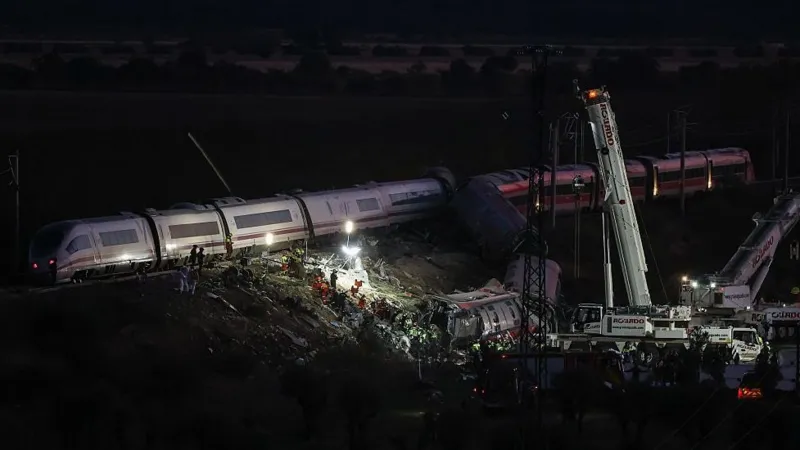
Spain is beginning three days of mourning after at least 68 people were killed and dozens more were injured in one of the worst rail disasters in Europe’s modern history.
Emergency crews worked through the night under powerful floodlights to cut open metal carriages in the search for victims, with many of those killed in the crash still to be identified.
Officials are investigating the cause of the disaster, which occurred when a train travelling from Madrid to Seville barrelled into a stationary train on Wednesday morning.
Prime Minister Pedro Sánchez said the “whole of Spain is grieving”, adding that “lives have been shattered, families have been torn apart, the pain is immense”.
Hundreds of personnel have been deployed to the disaster site to assist with recovery efforts, according to Spain’s interior ministry, with drones and helicopters being used to find victims and remove rubble.
The stationary train, run by private rail operator Iryo, had 147 passengers on board, and had stopped on the tracks because of a computer failure, according to Spain’s transport minister Óscar Puente.
He said that when there is a system failure, a 24-hour control centre in Madrid takes over, but it had made an “inexplicable” decision to instruct the trains to move again, without any speed restrictions.
Overnight, around 1,500 people gathered outside the Spanish Transport Ministry building in the capital, according to Spanish broadcaster TVE, which reported that demonstrators were largely calling for the resignations of Sánchez and Puente.
Police used tear gas to disperse crowds after protesters hurled bottles and flares. No injuries or arrests were reported.
Rail drivers are expected to go ahead with a planned strike on Thursday, with the Spanish Union of Railway Drivers (Semaf) saying the strike action will be held “in defence of railway safety”.
The leader of Spain’s main opposition People’s Party Alberto Núñez Feijóo said: “Spain has the right to know what is happening with its infrastructure.”

Late on Wednesday, relatives were still trying to gather information about passengers who were on either of the trains.
The Spanish Civil Guard has set up bureaus in Madrid, Toledo, Seville and Córdoba to investigate reports of missing persons.
“The top priority is the identification of the missing persons and the taking of DNA samples to be able to locate their relatives,” the civil guard wrote in a post on X.


Stay Informed With the Latest & Most Important News
Previous Post
Next Post







-
 01US used about a quarter of its high-end missile interceptors in Israel-Iran war, exposing supply gap
-
 02Pakistan army chief in Tehran to advance next round of US-Iran talks
-
 03Pakistan seeks oil deal with Russia as energy ministries hold talks
-
 04‘Trump Gold Card’ launches, offering expedited immigration pathway with a $1 million fee
-
 05Bangladesh’s BNP wins big in first election since Gen Z uprising, son of former ruler set to become prime minister
-
 06Libya’s army chief killed in air crash in Turkey
-
 07What senators are saying after being briefed on the US strikes on Iran