




Now Reading: Gaza welcomes Ramadan amid fragile ‘ceasefire’ and fears of renewed war
-
01
Gaza welcomes Ramadan amid fragile ‘ceasefire’ and fears of renewed war
Gaza welcomes Ramadan amid fragile ‘ceasefire’ and fears of renewed war

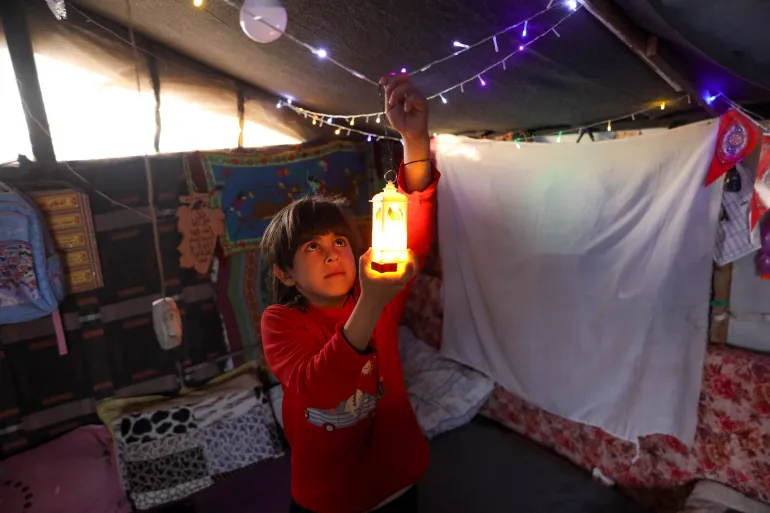
Despite displacement, Gaza families strive to create joy this Ramadan, navigating grief, scarcity, and fragile peace.
At the Bureij refugee area in central Gaza, Maisoon al-Barbarawi welcomes the Islamic holy month of Ramadan in her tent.
Simple decorations hang from its worn ceiling, alongside colourful drawings on the fabric walls, prepared by camp residents to mark the arrival of the blessed month.
“We brought you decorations and a small lantern,” Maisoon tells her nine-year-old son, Hasan, smiling with an exhaustion tinged with joy at her ability to buy him a Ramadan lantern.
“I wanted these decorations to be a way out of the atmosphere of grief and sadness that has accompanied us over the past two years during the war.”
Maisoon, known to everyone as Umm Mohammed, is 52 years old and a mother of two children.
“My older son is 15, and the younger is nine years. They are the most precious things I have.”
“Every day they are safe is a day worth gratitude and joy,” she says with pride mixed with fear, referring to the terror that has accompanied her throughout the war at the thought of losing them.
Like other Palestinians in Gaza, what distinguishes this Ramadan is the relative calm that has come with the current ceasefire, compared with the previous two years, when Israel’s genocidal war on Gaza, which has killed more than 70,000 Palestinians, was at its peak.
“The situation is not completely calm,” Maisoon explains. Everyone knows the war hasn’t truly stopped; shelling still happens from time to time. But compared to the height of the war, things are less intense.”


Related Posts

Stay Informed With the Latest & Most Important News



-
 01Middle East crisis live: malnutrition in Gaza on ‘dangerous trajectory’, says WHO, as airdrops of aid begin – as it happened
 -
 02Pakistan bombs Kabul: Why are Afghanistan and Pakistan fighting?
 -
 03Trump’s world order hangs over Europe on eve of key defence conference
 -
 04Israel to reopen Gaza crossing after search for last dead hostage’s body ends
 -
 05Russia accuses Estonia of airspace incursion falsity to stoke tensions
 -
 06The ‘Fourth Successor’: Iran’s plan for a long war with the US and Israel
 -
 07UAE denies Netanyahu visited in ‘secret’ during US-Israel war on Iran