
Now Reading: THE WAR AGAINST IRAN AND PAKISTAN’S MOMENT
-
01
THE WAR AGAINST IRAN AND PAKISTAN’S MOMENT


“There are strategic attacks that have led directly to peace, but these are the minority. Most of them only lead up to the point where their remaining strength is just enough to maintain a defence and wait for peace. Beyond that point the scale turns and the reaction follows with a force that is usually much stronger than that of the original attack.”
— Carl von Clausewitz, On War
“Conflict remains the Middle East’s most troublesome dynamic, but there is today less to this problem than headlines might lead one to believe. Iran — the region’s chief destabilising force — has been greatly weakened… As this administration rescinds or eases restrictive energy policies and American energy production ramps up, America’s historic reason for focusing on the Middle East will recede.”
— US National Security Strategy, 2025
“There is no terror, Cassius, in your threats,/ For I am arm’d so strong in honesty/ That they pass by me as the idle wind,/ Which I respect not.”
— William Shakespeare, Julius Caesar
“Woe to the land that’s governed by a child.”
— William Shakespeare, Richard III
PROLOGUE
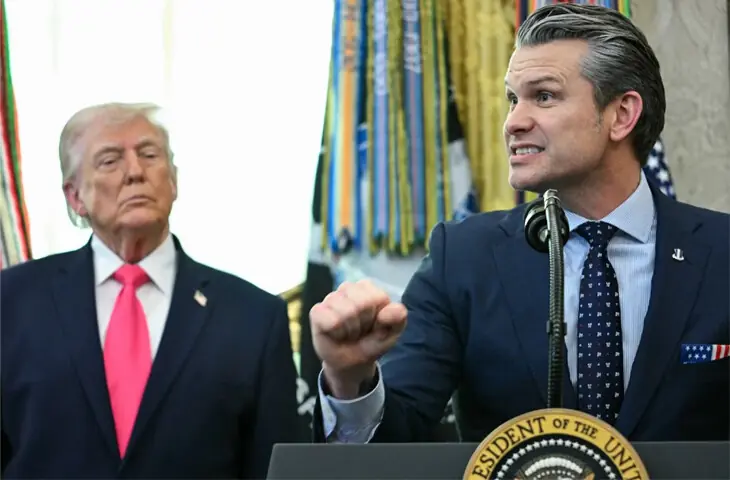
The second round of talks between Iran and the United States scheduled for last Wednesday in Islamabad remained stillborn. Reason: US President Donald Trump is still averse to negotiating. He thinks that negotiations are spelled D.I.K.T.A.T. That is a non-starter.
The inordinate time he spends putting out mocking posts in all caps, he was already set to sabotage the process. Publicly insulting the other party is not the best way to go into talks. One doesn’t need to learn negotiations theory at Harvard to figure that out.
Second, there’s a growing corpus of literature on the disruptive nature of “Twiplomacy”. The general consensus among scholars is that it is dangerous for serious diplomacy and negotiations because social media fundamentally alters the speed, substance, and secrecy of traditional negotiations.
To put it in perspective, imagine Clemens von Metternich or smartphone-carrying X-ers in the five major powers of the time tweeting about what he was doing to put together the Concert of Europe, an exercise so complex that it just couldn’t have been done without secrecy, aristocratic exclusivity, and slow, deliberate, face-to-face negotiations among elite diplomats. In the era of twiplomacy, Metternich’s gravitas would have collapsed irredeemably.
As Washington and Tehran oscillated between escalation and diplomacy after the war imposed by the US and Israel on Iran, Pakistan emerged as an unlikely but structurally primed mediator. Ejaz Haider unpacks the conflict so far, where we stand now, the limits of coercion and Pakistan’s role in helping to forge peace
Three, the refusal of Iran to send a delegation should have been anticipated. That the second round could not happen doesn’t necessarily reflect on Pakistan’s efforts. Tehran simply cannot be seen at the table with the US while the blockade continues. As I wrote in this space in early March, nor can Iran negotiate away the three pillars of its security: nuclear latency, missile programme (now also drones) and regional relationships.
Iran’s position remains more circumscribed. It has signalled willingness to limit enrichment temporarily, reduce stockpiles, and accept international monitoring in exchange for sanctions relief and unfreezing of its money. Missile forces and regional relationships were/are not on the table. Further, a second war in the middle of talks has also made it imperative for Iran to demand a guaranteed, comprehensive non-aggression pact.
Four, Trump doesn’t have many good choices. Bluster aside, he can’t really escalate without bombing targets that would make him a war criminal under existing International Law provisions. Granted he could wave that off as a minor nuisance and still go ahead.
But would that force Iran to capitulate? Highly unlikely. Would it kill thousands of civilians? It would. Does the world have an appetite for such savagery? No, leaving aside the horrendously murderous Zionist entity. Would Iran retaliate? Absolutely. Would such escalation send regional and extra-regional economies in a tailspin? Most certainly. Could it result in a diplomatic solution in the US’ favour? Forget it.
Action: extremely high risk. Result: very dubious to zero payoffs.
Five, to other sticking points we now have the added problem of US naval blockade of Hormuz. Everyone keeps talking about a ceasefire — to the extent that bombing has been paused, yes — but the blockade under relevant International Law provisions is an act of war. The ceasefire, to that extent, is already deceased, like the dead parrot in Monty Python.
The central question is, how long can the blockade be sustained? Iran believes, and has stated this in so many words, that it can outlast pressure. It’s the same clock versus time dialectic the US faced in Afghanistan. The underdog, if it can take and absorb pain, turns time into a strategic asset.
As Dennis Citrinowicz, a former intelligence officer and Iran expert for the Zionist entity, has written: “This is not a solution, it is a path towards deeper instability. This is a strategy of delaying the inevitable [by Trump] rather than resolving the conflict.”
With this inverted pyramid, let’s look at what Iran’s operational and politico-strategic approaches have achieved so far and also at Pakistan’s mediation efforts.
RECAP
Like last year, when Iran was attacked in the middle of talks on the nuclear file, this time, too, it was attacked while the talks were ongoing. This time, it was Operation Epic Fury (have US military planners outsourced op code-naming to professional wrestlers?). The gambit was decapitation and degradation strikes. Pesky Iran was supposed to crumble and sue for peace. Trump was to boast about the beauty of his operation.
But Iranians are nothing if not vexatious. They absorbed the pain and began counter-attacking, escalating horizontally, using missiles and drones, hitting US bases and bringing the Gulf to a precipice. Then, when their infrastructure was hit, they hit back at infrastructure. Worse, they closed the Strait of Hormuz. Trump suddenly realised they have swarms of these small, pestiferous high-speed boats, the naval equivalent of bees attacking a bulldozer.
Meanwhile, Trump, who cannot be accused of strategic coherence, declared on Truth Social on March 1 that Iran would be “hit so hard they won’t recognise what’s left of their sand.” By March 3, he was musing that “honestly, a little bombing never hurt anybody”, before pivoting to complain about the price of eggs. On March 7, he announced that “the only thing Iran understands is strength, and we have the biggest, most beautiful bombs, believe me.” Forty-eight hours later, he suggested that Iran’s Supreme Leader was “actually a very smart guy, very smart, maybe we can do lunch.”
By mid-March, he had oscillated between threatening to destroy an entire civilisation and praising the “fantastic engineering” of Iranian drones. When a reporter asked him on March 20 whether the US was at war, he replied, “It depends what your definition of war is. Also, I never said war. I said kinetic peace. Great phrase. Someone give me credit.”
It is strategic whiplash meets performance art meets a man who genuinely cannot remember what he posted on X 20 minutes ago, leaving allies exhausted, enemies confused, and everyone mulling over Richard III’s line, “Woe to the land that’s governed by a child.”
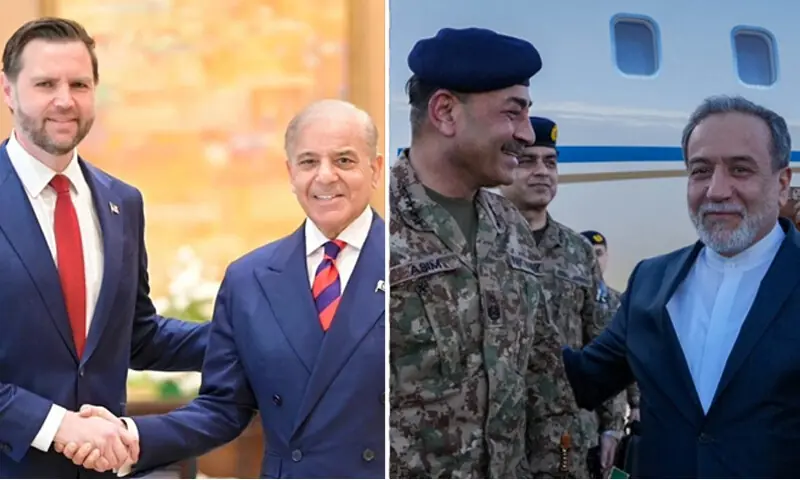
Enter Pakistan, the awkwardly useful middle child of global diplomacy, with its ‘Trust Me, I Know Everyone’ moment. Islamabad, which somehow (we shall get to that) maintains a “strategic partnership” with China, a defence pact with Saudi Arabia, a tense border with Iran, and an on-again-off-again love-hate thingamajig with the US, realised it was the only one everyone was still on speaking terms with.
So, the Chief of Defence Forces Field Marshal Asim Munir got busy, looking like a man who just wanted (still wants) everyone to calm down and have some chai. It’s a classic Pakistani hustle, using the fact that no one hates you enough (India excepted!) to ignore you, and everyone needs you enough to listen to you.
Whether this ultimately ends in a peace deal — much is being speculated on that count — or just an awkward family dinner, where someone leaves early in a huff, remains to be seen. But for now, the bloody playground fight has an unexpected field monitor, if you will.
But the real problem is Trump. We don’t know if he really wants out. Maybe he does; maybe he is still playing the same game. Be that as it may, unless he can be kept away from his phone and making insulting statements, diplomacy will remain complicated and Iranian moderates will have a much weaker hand to play.
THE SCHRÖDINGER MEME AND IRAN’S STRATEGIC CHOICES
Someone started it. It went viral. Talks are dead/talks are alive. Strait is open/strait is closed. But if one were to go into the history of Schrödinger’s cat, it is spot-on. Schrödinger intended for the “dead-and-alive” cat to prove that quantum mechanics was incomplete and that large-scale objects cannot be in two states at once. He was wrong on that count but he was also right in a way.
The cat, used as a metaphor, can be both dead and alive. Niels Bohr and Werner Heisenberg were right. In this situation, too, we have that duality and it depends on where one is observing it from: Washington or Tehran. Nota Bene: there’s no known idea in physics that accounts for the perfidious trinity involving the Zionist entity!
Iran has now been attacked twice, both times in the middle of ongoing talks. For anyone to tell it that the cat is alive in terms of talks would need a lot of convincing. The play has become obvious: send Steve Witkoff and Jared Kushner to conduct “negotiations,” and declare that the only acceptable “negotiated” outcome is one that would require Iran to meekly submit to the US. In other words, surrender. Remember Trump’s words? Unconditional surrender.
Before the war began, Iran was negotiating but also preparing for a conflict. This much should be obvious from several interviews given to international television channels by the country’s foreign minister, Abbas Araghchi.
Its war preparations had four interconnected strategies: dispersal and delegation (mosaic defence); succession redundancies to offset the impact of decapitation strikes; horizontal escalation to raise the cost of war; and using allies as strategic reserves. Blocking the Strait of Hormuz was also an obvious part of the strategy of raising the cost of war.
To put it another way, Iran’s operational strategy was to fight its own war against the US-Zionist duo, not get into the conflict on the US’ terms. I have made this point before in this space through a children’s fable by Aesop but it bears repeating.


Related Posts
Stay Informed With the Latest & Most Important News
Previous Post
Next Post


-
 01South Korea military shrinks by 20% due to low birthrate
 -
 02Ukraine, Saudi Arabia sign air defence deal: senior officials
 -
 03Trump says Iran regime change is ‘best thing that could happen’
 -
 04Iran war: What’s happening on day 59 amid diplomatic push to end conflict?
 -
 05CIA assesses Ukraine was not targeting a Putin residence in drone attack, contrary to Kremlin claim, sources say
 -
 06Security forces kill 11 terrorists during IBOs in Balochistan’s Kharan, Washuk districts: ISPR
 -
 07Hulk Hogan’s cause of death revealed