




Now Reading: ‘Cashless bail’: The origins of the bail reform movement and why Trump wants to end it
-
01
‘Cashless bail’: The origins of the bail reform movement and why Trump wants to end it
‘Cashless bail’: The origins of the bail reform movement and why Trump wants to end it


President Donald Trump wants to eliminate “cashless bail” in the nation’s capital and across the country.
But what exactly does that mean, and what is the controversy all about?
“Cashless bail” is a term for criminal justice reform policies that have upended the traditional practice of making bail – allowing people to pay to be released from jail before trial. Instead, reformers have called to replace that money-based system with one that focuses on public safety, defendant’s rights and ensuring people accused of crimes return to court.
Washington, DC, the immediate target of Trump’s ire, removed cash bail in most cases in 1992. Democratic-controlled states like New York, California and Illinois have passed bail reform laws in recent years, as have Republican-controlled states like Alaska and, under Republican Gov. Chris Christie, New Jersey.
Bail reform advocates say a person who has been accused of a crime, but not yet convicted, shouldn’t be held in jail based on what’s in their bank account.
“The overall justification to move away from a money-bail system is basic fairness,” said Insha Rahman, the vice president of advocacy and partnerships at Vera Action, an advocacy group. “There should not be two systems of justice, one for the poor and one for the rich.”
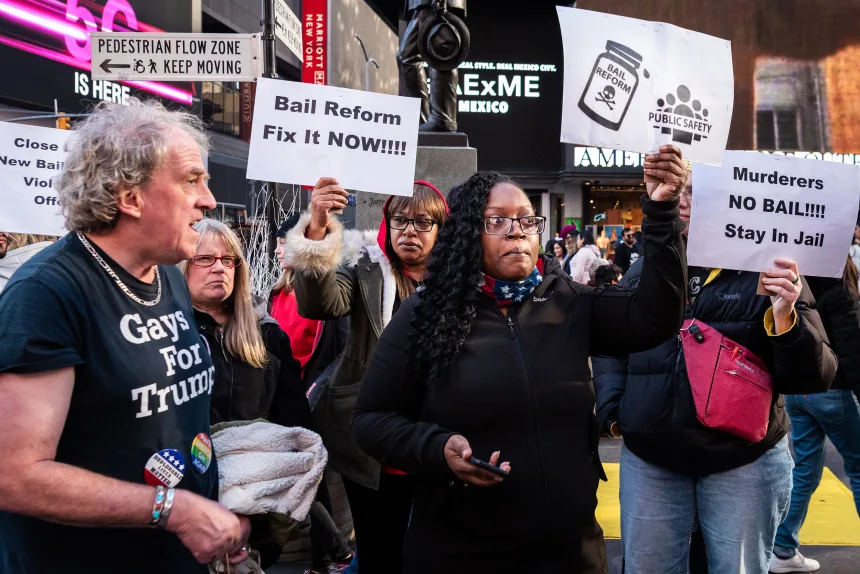
But the reforms didn’t just limit or eliminate cash bail – they also made certain lower-level crimes ineligible for pre-trial detention. Opponents of the reforms say they have tied judges’ hands and created a revolving door of people repeatedly arrested and then immediately released.
“You have ‘turnstile justice’ where recidivists have been arrested for the same crime hundreds of times … and you can’t impose bail,” said James Gagliano, a retired FBI supervisory special agent and doctoral candidate at St. John’s University. “It’s wrong and it doesn’t fix the system.”
The basics of how bail works
In general, when you are arrested and accused of a crime, you are taken to court in short order for a detention hearing.
There, a judge hears some of the allegations and evidence and then decides whether to keep you in jail before the trial. The judge can also decide to let you out until trial under some conditions, known as bail.
Typically, bail includes a monetary amount that is returned to you at the end of the case. Bail can range from the non-monetary “personal recognizance” to thousands or even millions of dollars. The amount is ostensibly based on some combination of the severity of the crime and a total that incentivizes you to come back to court for trial.
The teenager who spent 3 years in Rikers because he couldn’t pay $3,000



Related Posts


Stay Informed With the Latest & Most Important News
Previous Post
Next Post






-
 01Uzbekistan’s Center of Islamic Civilization is a space of enlightenment and inspiration
 -
 02Why India’s RSS is lobbying the West amid attacks on minorities at home
 -
 03Trump said he was ‘sharper than I was 25 years ago.’ Then he spent an hour appearing to doze off – again
 -
 04B-52s arrive at UK air base amid conflict with Iran
 -
 05Ukraine racing to develop new interceptors as Russian drones and missiles ravage the country
 -
 06Jets, chips and a clean slate: Saudi Arabia’s crown prince got almost everything he wanted from Trump
 -
 07US-Iran talks in Pakistan: Who’s attending, what’s on the agenda?